
 Time to set a goal for this week! Here are some AMAZING tools to help get your toddler talking. My suggestion: rate yourself on how well you are already doing, and then pick one skill to work on at home this week. For more information on helping your toddler talk check out this blog post: encouraging-my-child-to-talk.html
Wait for your child to try! Don’t cater to your child’s every need or want before they have a chance to communicate with you. Observe their actions, wait for them to interact with you, and then listen!! How often are you waiting? Never - Rarely - Sometimes - Often Mess things up: Mess up routines so your child has to communicate his or her needs. Example: During mealtime give everyone a spoon but “forget” to give your child a spoon. Wait and see if your child initiates they need something. If they don’t initiate what they need, help them by saying. “What do you need?” or “Are you missing something” or “Uh-oh!” Label the item before you give it to them. Do you ever mess up the routine? Never - Rarely - Sometimes - Often Parent Speech: Use clear simple speech with your child during play routines. The goal is to talk in phrases you want your child to copy. Use one or two words more than your child is using. How often do you use Parent Speech? Never - Rarely - Sometimes - Often Use add-ons: Add 1 or 2 words to what your child says when you respond back to him or her. Example: When your child says “up” say “up… you want up”. How often do you use add-on? Never - Rarely - Sometimes - Often Narrate your life: When your child is within hearing range, talk about what you are doing while you do it. Example: When washing your hands at the sink say “I'm washing my hands”, when the phone is ringing say “I hear the phone”. How often are you narrating your life? Never - Rarely - Sometimes - Often Narrate your child’s life: When playing with your child, describe what your child is doing while they are doing it. Example: When your child picks up a car – say “pick up the car”. When your child drops a block – say “you dropped the block”. How often are you narrating your child's life? Never - Rarely - Sometimes - Often Hopefully this list gives you an idea of a skill to focus on this week. You can do it!!!
0 Comments
My son had his phase 1 orthodontia work done a little over 2 weeks ago. This included getting an expander to widen his palate and braces to help close the gap between his front two teeth. I thought I was pretty prepared to deal with all of the metal he now has in his mouth because:
-I am a speech language pathologist! Mouths are like totally my domain, right? -I have had clients get expanders and braces. -I had braces growing up...been there, done that! Oh boy, I was SO WRONG! The first two days were incredibly difficult for my son, and by extension, me. So together we (my son and I) decided to make a list of things we wish we had known going into this whole new world. 1) Best foods for the first two days: hard meltables (grahm crackers, animal crackers, Ritz crackers, etc.) These types of foods are hard enough that you have to chew them, which is good for practice and according to my orthodontist decreases mouth pain. BUT they also melt if they get stuck in your mouth, like under the horrible expander bar. A banana is soft but once its squishiness is stuck in all the new metal grooves in your mouth it doesn't go away...it just gags you. Other good choices: smooth things you don't have to chew (apple sauce) and cold things (frozen yogurt). 2) Small bites are a big deal: cut things up really small for your child, especially in the beginning. This was super important for my son. 3) Meals take a long time: eating is going to be slow going for at least the first week. My biggest suggestion, call your school and ask them to let your kid be first in the lunch line for his class for the first few days. This super helped my boy. 4) Use sips of water to rinse: eating at first is super messy! I found that having water available for my son to use to rinse his mouth after every couple bites was a must. Another good strategy we tried to help get food out of his braces/expander was to send a little travel toothbrush with him to school for after luch. 5) Swallow that spit: for the first two weeks my son had a lot of extra saliva to deal with. His mouth was working overtime which led to some crazy drooling. I found that if I cued my son to swallow his spit his speech cleared up and he didn't drool on his homework. All good things. The spit is out of this world! Good news, it does slow down with time. 6) Practice oral reading: the first week or so really push oral reading at home. This gives your kid the chance to refine his speech sounds. His tongue has to change the way it moves now when he goes to make /s/, /z/, "sh", /r/, /l/. His lips move differently to say /p/, /m/, /b/. Things will be pretty sketchy for a while. The more your child can hear his own voice in a safe environment the better he will get at producing his sounds clearly once more. If you want to know more check out: The Auditory Feedback Loop. 7) Really push oral hygiene: my son had been brushing and flossing his own teeth religiously before getting his braces and expander. After getting his gear I let him continue to brush his teeth and I took over flossing, because it is super tricky. BUT two weeks in he had major plaque issues because his brushing technique was not cutting it. I suggest for the first few days you really watch his brushing AND help with flossing. Also I wish I had actually tried flossing his teeth in the orthodontist's office the day he got his braces instead of just watching. It is way harder than it looks, especially the back teeth. Get all the tips you can before trying it on your own at home! Hopefully reading through some of our tips will help make the first few weeks of your child's (or your own) orthodontia experience a little more manageable! 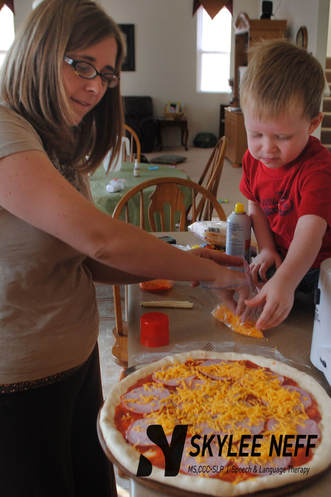 Mom! I'm hungry!! Can I have a snack? Who has heard that before? Like 10 times, or 20 times... and it's 10:30 am. Am I right? Lucky for us, making meals and snacks can be a super excellent way to work on speech and language AND feed your starving child. It's a win-win! When I first started working in early child development, a mom told me the most valuable thing she had learned so far was how to talk and be with her kid while he was eating. She told me that before her therapy services, meal and snack times were all about getting other stuff done while her son was busy eating. BUT once she started using some of the following tips her son's language really started exploding. Building Vocabulary
Using My 5 Senses
Beginning Literacy
Imagination and Guesses
Repetition is key!
Check it out! My first speech and language therapy video!!
I reviewed a new toy that I bought at www.smartfelttoys.com. For the month of April it is 20% off in honor of World Autism Awareness Month, use the Promo Code: WAAD. Hooray for discounts on specialized SUPER AWESOME toys!!  One of the most important things to me in my private practice is being able to better meet the needs of the families I was serving. As of this spring I will have been providing private speech and language therapy for six years. Starting this business has been a perfect fit for me and my therapy style BUT I decided to ask some of my clients how private therapy met their individual needs. I am grateful to my clients for taking the time to let me know which aspects of my private therapy practice they felt most met their needs.
I asked to share some of their responses just in case you are debating private therapy and want to know a little more about what families come away with after their time in private speech and language therapy. "I was always so happy with your visits. I felt you always gave me and my boys great instruction on what to work on and how to implement it! We never had any unmet needs. You're truly the BEST!!!" "Our biggest need when we considered private speech therapy was to get the best care possible. Services (through the school district) didn't seem like a good option as the therapists are overwhelmed with too many children and I didn't feel as though we would get personalized car. We wanted more of a personal, one on one experience. Private therapy met those needs." "You helped a ton with teaching the proper techniques to get the sounds to come out the right way. Because of that my son still remembers to get the end sounds when he uses the strategies you taught him. Both of my boys benefited greatly from working with you." "I would say my biggest need was having him do it one on one. Getting an individualized plan for him. Me being able to be part of the "treatment/plan" so we were both being consistent and teaching him the same words, hand signs, etc. I felt more informed and better able to help him." "I really liked the on on one. My son needed that extra attention and really excelled from it. When in his school lessons (for the few weeks he took) he was overshadowed by other students, some needed more attention than others. I also liked how once he could move on to the next lesson he did. In school sessions he had to wait for the whole group. All of the fun activities you added always kept him interested as well (verses just worksheets in class)." "Private therapy helped meet major communication barriers, helped give her the tools and confidence to correct and make sounds that she wasn't able to make, also you made speech fun and she responded really well to that." I see a lot of preschoolers in my private practice, and with good reason. Preschoolers (ages 3-5) are right in the middle of some of the most important language learning years. You see a huge change in how a child communicates during this time. Preschool is a golden time to target language skills.
Because these kids are not in all day school yet, home is still their main source of language and learning. Preschool children no longer qualify for Early Intervention which means they (might) get some preschool services through their school district BUT families miss out on the parent training that comes with Early Intervention. If you have questions about how you can help your preschooler at home I have some resources that might help! Preschool Development - This is the page I just finished with information about preschool language skills and tips to help you work on some of them Helping My Preschooler Learn to Learn - This is a blog post featuring some ideas on ways to help a preschooler learn new things Summer Pre-K Program - In this blog post I share a program that I use to introduce or review new letters/sounds the summer before kindergarten. Have fun with your preschooler and should you have questions or concerns don't be afraid to reach out to your pediatrician, preschool teacher, or SLP! Introducing my brand new page! Several months ago Emily Hewlett contacted me asking if there was any way we could work together to help get parents more resources regarding growth and development. She was working on her MS degree in Public Health and needed a Preceptor to oversee her Practicum. I was delighted to help because getting development handouts for parents has been on my wish list for ages. Her final product is AMAZING and you can read more about it in my previous blog post. Today I sorted her handouts into developmental stages and created a new page for my website. You can find it at the top right hand corner of this page or you can just CLICK HERE!
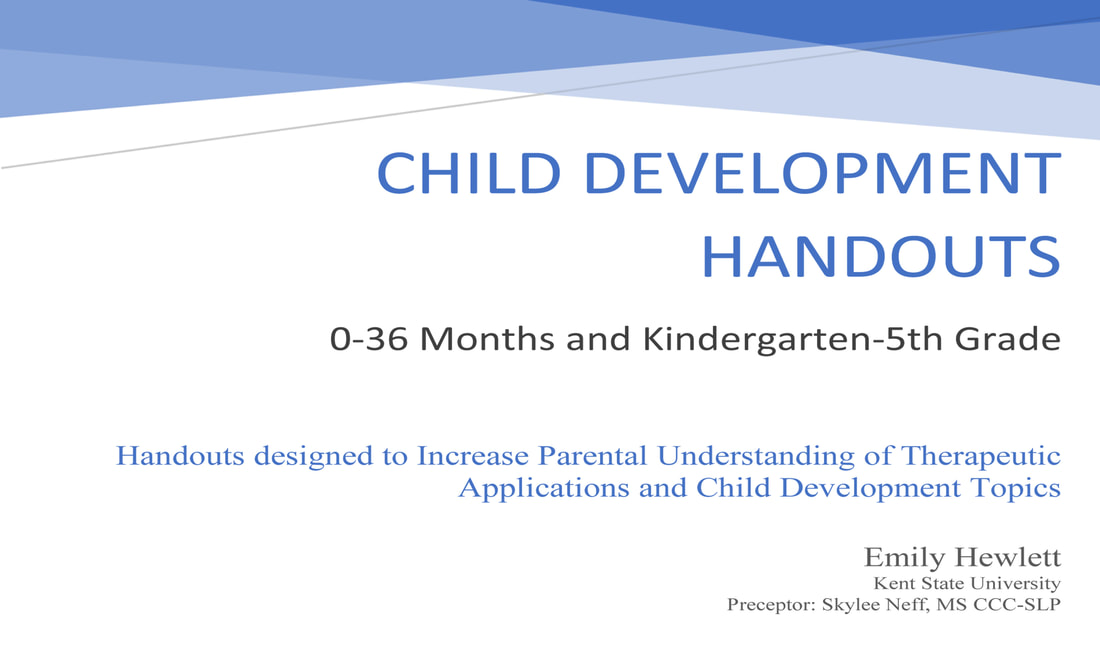 HUGE BIG NEWS!!! I now have an amazing new FREE resource on my website. Introducing the "MEGA Parent Information Book: Milestones". This resource was created for me by Emily Hewlett as her practicum while working towards her Master of Public Health degree at Kent State University. I am in the process of creating little mini-handouts divided by age and skill set BUT in the mean time go to my SLP Resources page and download the entire book...who knows when you'll need it!?!
In my practice I see a lot of kids with low speech intelligibility. What is my go to technique to help these kids form a sound? A quick hand sign or tactile cue. I have found in my practice that when kids are having a very difficult time producing a sound these kinds of cues really help...so I thought I would share! A visual hand sign is a little reminder that you can give your child to help them remember what to do with their mouth. Something like this: Tactile cues are a little different from visual cues because they involve lightly touching your child's jaw/lips/nose etc. to remind them where and how to shape a sound.
Some examples of tactile cues can be found in this awesome link created by Wendy Ryback, MA, CCC-SLP. Research has found that tactile cueing is particularly effective for kids with Childhood Apraxia of Speech (see ASHA's Apraxia of Speech Portal). I don't strictly use these approaches. My cues change based on things like the age of the child or the severity of their speech delay, or the types of errors a specific child is making. BUT the above resources are a great way to try giving your kid some more specific help with sounds you are concerned with. As always if you have additional questions or concerns talk with your pediatrician or local school district SLP! "A surprisingly high percentage of children who start school have disabilities-- Today I ran across an magazine article called "Getting a Jump on Learning" (you can read the entire article too by clicking HERE). The author, Michael L. Robinson, supports the idea of helping preschoolers, ALL preschoolers prepare for kindergarten by gaining the capacity to learn.
These are the main strategies that Robinson suggests:
Wow, pretty awesome advice. My background in speech and language totally supports all of these ideas. Active learning really does help you encode new information better, which leads to better myelination of the nerve pathways, which leads to better retention and retrieval. Learning through our senses promotes active learning, and also provides language regarding function words and adjectives. Pointing out details and differences will help give your child a rich vocabulary that he can use when organizing his thoughts and will increase comprehension. Giving your child opportunities to succeed will help him learn persistence and gain self-confidence. Try to provide opportunities that challenge your child but are also within his reach. It is no good failing and failing again, kids need to be able to be successful. Don't get so stressed about learning letters and numbers that you are missing these kind of learning opportunities. There is SO much more to learning than rote memorization, sometimes I think parents feel pressure to see their kids perform rather than help them learn. Relax, have fun, and talk talk talk to that preschooler! |
|||||


 RSS Feed
Click to set custom HTML

Copyright © 2026